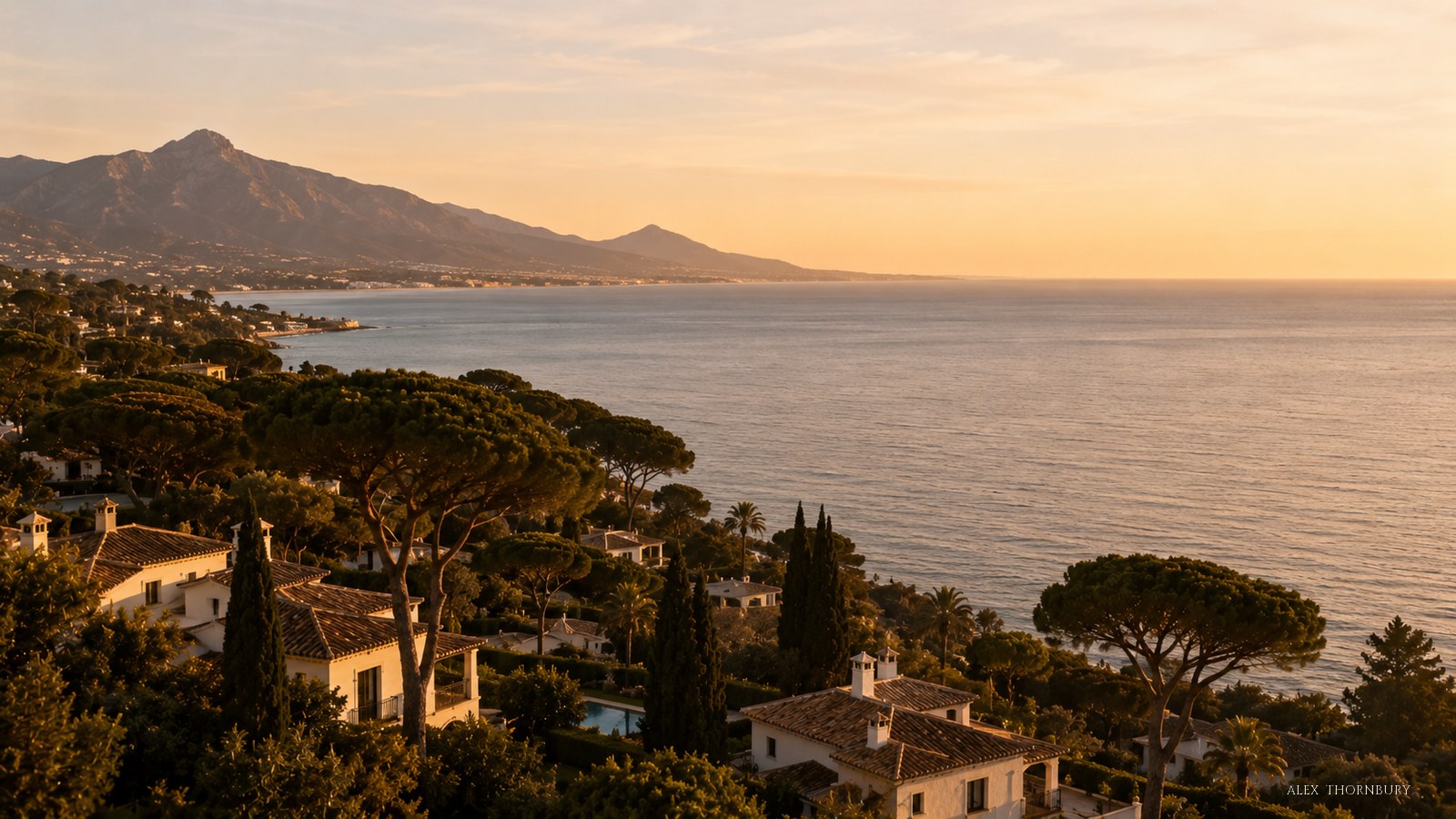
Mediterranean prime is not one market and it is not stable in 2026. International UHNWI capital is rotating away from the most established sub-markets in measurable ways, and the second-tier alternatives are catching up faster than the consensus expects.
The established positions: still deepest, no longer cheapest
Marbella, the Côte d'Azur, Mallorca and Lake Como remain the deepest sub-markets for European prime, with the most professional services, the most established expat communities and the most reliable long-term liquidity. Pricing at the top tier — EUR 15-40 thousand per square metre depending on the sub-market and trophy positioning — reflects that depth. These are positions where international buyers continue to commit serious capital because the alternative is not yet trusted at scale. For three of the names buyers most often weigh against each other, see Monaco, Marbella and Mallorca compared.
The rising sub-markets
Three Mediterranean sub-markets have moved materially from the second tier into the first tier of international consideration in 2024-2026. Antiparos in the Cyclades has become the discreet Mykonos alternative, with prime villas at EUR 5-9 thousand per square metre and the social environment that the original Mykonos buyer claims to want. Comporta in Portugal's Alentejo, an hour south of Lisbon, has attracted the design-conscious end of the international market with EUR 4-8 thousand per square metre for prime new-build in the dunes. Calabria's Tropea coastline, almost unknown to international buyers in 2020, now sees regular EUR 3-6 thousand per square metre transactions in restored historical positions.
What the rotation tells us
The rotation is not principally about price. The rising sub-markets are not cheap on a comparable-property basis; they are differently expensive. The capital moves because the established sub-markets have, for some buyers, become uncomfortable: too many of the wrong neighbours, too much new-build at the wrong end of the spectrum, too much tourist seasonality. The rising sub-markets offer scarcity and discretion that the established positions no longer guarantee.
Where prime capital is rotating to within the established markets
Within the established positions, prime capital is rotating in identifiable ways. In Mallorca, the rotation is from the south-west (Andratx, Santa Ponsa) to the Tramuntana villages (Deià, Valldemossa, Sóller). In Marbella, from the seafront Golden Mile new-build to the Sierra Blanca and La Zagaleta gated estates. On the Côte d'Azur, from the over-photographed Saint-Tropez stretch to the quieter Cap d'Antibes and Saint-Jean-Cap-Ferrat positions. The common pattern: away from visibility, towards discretion.
The honest read on where this ends
The rotation looks like the start of a longer cycle, not a momentary distortion. The driver — discretion-seeking UHNWI buyers moving up-market within established positions and out-market to rising positions — is a structural shift, not a one-year trend. Buyers committed to a ten-to-fifteen-year hold should map their target sub-market against this rotation: positions that look like value today may be in the path of the rotation, but positions that look like value today only because the rotation has not yet reached them carry a different kind of risk.
Source: Knight Frank — The Wealth Report 2026: Property
Source: Knight Frank — Europe's Prime Markets in 2026
Source: Knight Frank — Prime Residential Property Index (PIRI 100) 2026