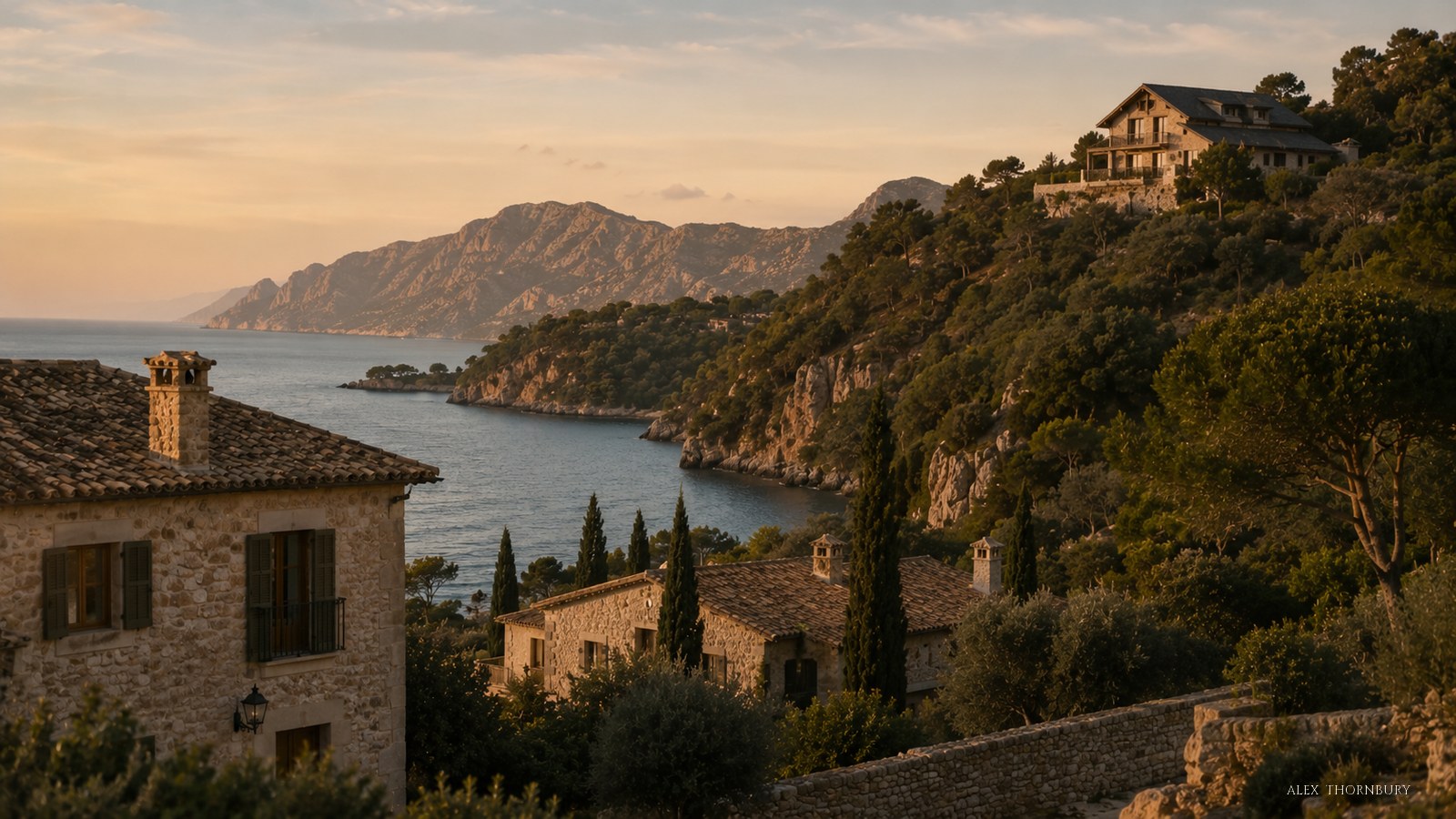
Spain has been the largest single destination for European luxury property capital for most of the last decade. The composition of that capital has shifted materially in the last 36 months, and the sub-markets that look like the same Spain on a spreadsheet have diverged sharply in lived reality.
Marbella: the mature market thesis
Marbella's Golden Mile and La Zagaleta have been the canonical European UHNWI destinations for forty years. The thesis remains broadly intact: a mature market with deep professional services, established expat communities, year-round flying weather, and one of the most generous autonomous-community tax positions in Europe (Andalusia's effective elimination of ISD for direct-line successions, low headline IBI, and reasonable ITP). The current cycle has seen meaningful price growth at the top end (EUR 12-25 thousand per square metre for prime new-build) but the market is no longer cheap relative to the alternatives.
Mallorca: the discretion premium
Mallorca runs at a discretion premium to Marbella. The buyer profile is German-Scandinavian-British rather than the broader European-Gulf mix Marbella attracts. The Tramuntana side of the island (Deià, Sóller, Valldemossa) commands EUR 10-18 thousand per square metre at the top end; Palma's Old Town is in a similar range. The island's appeal is not principally tax — the Balearics retain a meaningful ITP up to 13 per cent on prime transactions — but lifestyle, sailing, and the social environment around the Real Club Náutico de Palma's calendar. Ibiza is the other Balearic story: Santa Eulària des Riu has topped Spain's official appraised home values every quarter since mid-2022, ahead of every Mallorca municipality in the same table, and that is the backdrop to Ibiza's prime market.
Barcelona: the city hedge
Barcelona is the city hedge in a coastal-property portfolio. The prime sub-markets (upper Eixample, Pedralbes, parts of Sarrià-Sant Gervasi) trade at EUR 8-14 thousand per square metre. The tax position is materially worse than Andalusia — Catalonia's 27 June 2025 ITP reform tiered the transfer tax to 10/11/12/13 per cent across brackets up to and above EUR 2 million — but the city's professional services, schools and connectivity remain a draw for the family that wants a Spanish base without committing to a coastal lifestyle.
The Balearic ISD reform
The 2024 Balearic reform of the Impuesto sobre Sucesiones y Donaciones (ISD) introduced a near-total bonificación for direct-line heirs, putting the islands broadly on the same footing as Madrid, Andalusia, Cantabria and La Rioja. Pre-2024, Mallorca-resident families faced meaningful succession exposure that compromised the long-term tax case for the island. Post-2024, that exposure is essentially eliminated for direct-line transfers. The reform has been one of the more material developments in Spanish prime-property economics in the last five years and most international buyers have not absorbed its implications.
Where to be cautious
- New-build prime-tier developments in the Costa del Sol have absorbed substantial capital in the 2022-2025 cycle; absorption rates are slowing and the assumption that prime is always liquid should be tested.
- Catalonia's 2025 ITP reform has materially weakened the after-tax economics of Barcelona prime versus comparable Andalusian or Balearic positions; buyers committed to Catalonia for lifestyle reasons should be explicit about the trade-off.
- Madrid has seen prime price growth that has detached from rental yields; the investment thesis is now substantially weaker than the lifestyle thesis.
- The Spanish wealth tax — for those without Beckham coverage — applies to Spanish-situated assets and is being actively litigated; current relief positions may not survive future reform cycles.